
TachoClear lets you record driving and breaks separately. This example helps you plan the later stop when your first break lasted 30 minutes.
Scope: a solo goods-vehicle driver working wholly in Great Britain under assimilated drivers' hours rules. The working-time notes apply where the Road Transport (Working Time) Regulations 2005 cover the driver. This is not guidance for GB domestic-only driving, Northern Ireland's separate working-time rules, passenger services, multi-manning or international/AETR journeys.
The second part has its own minimum
Article 7 of Regulation (EC) 561/2006, as it has effect in the UK, requires an uninterrupted break of at least 45 minutes after no more than 4 hours 30 minutes of driving, unless you take a rest period. Its split alternative is a break of at least 15 minutes followed by a break of at least 30 minutes, distributed over that driving period.
So an earlier 30-minute break can be the first part: it exceeds the 15-minute minimum. It does not reduce the later minimum to 15. DVSA explicitly rejects a split whose second part is shorter than 30 minutes.
A qualifying driving break is free of driving and other work and used exclusively to recuperate, under Article 4(d). Loading, paperwork or moving the vehicle interrupts that break.
A morning with an early 30-minute stop
This illustrative driver starts after sufficient rest, with no earlier driving in the current driving period and no earlier split-break first part. Every break shown is uninterrupted and meets the recuperation conditions. These are alternatives, not three consecutive parts of one shift.
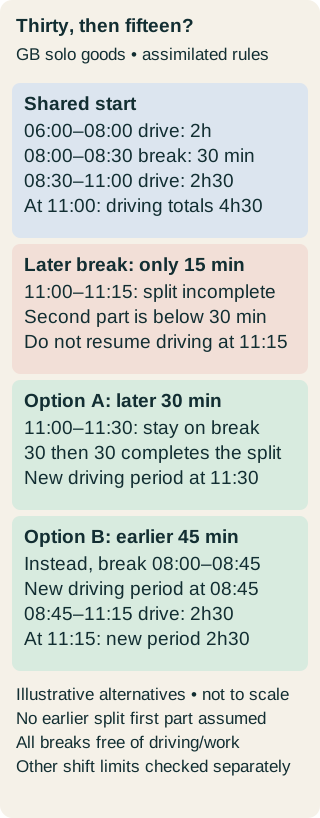
- 06:00–08:00: drive for two hours.
- 08:00–08:30: take a qualifying 30-minute break.
- 08:30–11:00: drive for another 2 hours 30 minutes.
At 11:00, accumulated driving is 4 hours 30 minutes. The earlier 30-minute stop has not reset that total. If the driver takes only 15 minutes from 11:00 to 11:15, the split remains incomplete. They must not resume driving at 11:15 on the strength of those two stops.
Two valid ways to plan the breaks
Option A: keep the earlier 30, take a later 30. Stay on the later break from 11:00 to 11:30. With no interruption, that second part lasts 30 minutes and completes the split. A new driving period starts at 11:30. The two breaks total 60 minutes; the extra time in the first part cannot be transferred to shorten the second.
Option B: make the earlier stop 45 minutes instead. If the first break runs uninterrupted from 08:00 to 08:45, it is a full qualifying driving break. A new driving period starts at 08:45. Driving from 08:45 to 11:15 then totals 2 hours 30 minutes in that new period. The day's driving still totals 4 hours 30 minutes: a break resets the driving period, not the daily total. See DVSA's explanation of a new driving period and daily driving time.
Check the actual uninterrupted duration. A 29-minute second part does not meet the 30-minute minimum; 30 minutes does. A 44-minute single break does not meet the 45-minute minimum; 45 minutes does. These boundaries come from Article 7, rather than rounding a stop up to the next quarter-hour.
Keep working time in view too
Driving breaks and working-time breaks have different tests. Where the 2005 Regulations apply, regulation 7, paragraphs (1) to (4) prohibits more than six hours of work without a break. More than six and up to nine hours of work needs at least 30 minutes of breaks interrupting the work; more than nine needs at least 45. Each part must last at least 15 minutes.
Breaks can satisfy both rulebooks when they meet both sets of conditions. DVSA's working-time guidance confirms this. Meeting the working-time break total does not turn a 30-then-15 pattern into a completed driving split.
The morning above contains 4 hours 30 minutes of work, all driving. It does not establish the break total needed for the whole day if more work follows. For a complete example with loading and unloading, read the illustrated working-time shift.
Before you move off
- Check driving accumulated since the last completed driving break or rest.
- Check whether an earlier qualifying first part exists.
- Check the later break's uninterrupted duration, rather than adding two numbers.
- Check working time, daily and weekly limits, rest and any other applicable requirements separately.
Record the activities you actually performed in your tachograph. Use TachoClear alongside it to record and plan your shift; the app does not amend the tachograph record. You can also read the short split-break reference.