
Quick answer
For a van over 2.5 tonnes and up to 3.5 tonnes (its maximum permissible mass including any trailer, not the load):
- Work stays in Great Britain: GB domestic rules normally apply. No tachograph needed.
- UK–EU or cabotage, carrying someone else’s goods for payment: EU-style rules and a full smart 2 tachograph.
- UK–EU, your own firm’s goods, driving is your main job: EU-style rules and a tachograph.
- UK–EU, your own firm’s goods, you mainly do another job: exempt only if every condition below is met; then no tachograph is needed.
- To, from or through a country outside both the UK and the EU: the 2.5-tonne extension does not apply to AETR journeys, and the EU has separate arrangements with EEA countries and Switzerland. Check DVSA’s guidance and each country’s rules.
Answer three questions in TachoClear and it tells you which rules apply, or what to check, with the source. Not legal advice.

What changed on 1 July 2026
Article 2(1)(aa) of Regulation (EC) 561/2006, as it has effect in the UK, extends the assimilated drivers’ hours rules (the EU rules as kept in UK law, which TachoClear calls EU-style rules) to goods carried on international transport or cabotage (carrying goods within one EU country) where the van’s maximum permissible mass, including any trailer, is over 2.5 tonnes. DVSA’s goods-vehicle guidance, section 1, describes the same change and adds that it does not apply to AETR-regulated journeys.
When those rules apply, section 1 says the vehicle needs a tachograph and you record driving, breaks, rest, other work and periods of availability on it. The limits are the familiar lorry ones: 9 hours’ driving a day (10 twice a week), a 45-minute break after 4 hours 30 minutes, and daily and weekly rest. The road transport working time rules normally apply too.
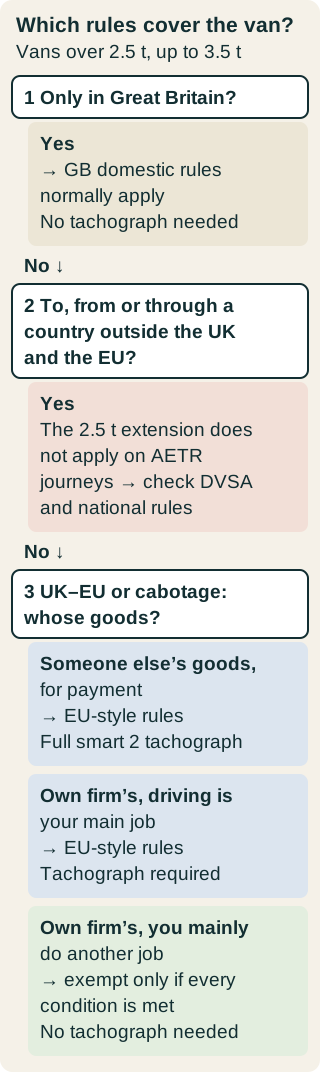
Three exceptions that decide most van work
1. Work that stays in Great Britain
Inside Great Britain the EU-style rules still start above 3.5 tonnes (Article 2(1)(a)); the 2.5-tonne extension is only for international and cabotage work. The GB domestic rules in section 2 apply instead: normally 10 hours’ driving and 11 hours’ duty a day. That section exempts goods vehicles up to 3.5 tonnes used for listed purposes, such as inspection, repair, installation or fitting, from the duty limit but not the driving limit — so vans of this size are covered. Section 4 confirms that goods vehicles over 2.5 tonnes and under 3.5 tonnes used only in the UK do not need a tachograph.
2. Your own firm’s goods, when driving is not your main job
Article 3(ha) exempts vans over 2.5 tonnes and up to 3.5 tonnes carrying goods on the firm’s or driver’s own account, not for hire or reward (carrying someone else’s goods for payment), where driving is not the driver’s main activity. Section 1.1 lists the conditions, and every one must hold:
- the goods belong to the business or are directly connected with it — sold, bought, hired, produced, processed or repaired by it;
- the journey serves the business’s own needs;
- you are its employee, under contract to it, or a sole trader — not an independent haulier;
- the business owns the van, is buying it on deferred terms or has properly hired it;
- carrying goods is secondary to the business’s main activity; and
- your main role is something other than driving: technician, engineer, builder or inspector, for example.
Where the exemption applies, section 4 says no tachograph is required for the international journey. If driving is your main job, or the goods are someone else’s and you are paid to carry them, the exemption does not apply.
3. AETR journeys
The AETR agreement is the European Agreement Concerning the Work of Crews of Vehicles Engaged in International Road Transport; DVSA lists the countries that have signed it. A trip from, to or through one of them is under the AETR rules for the whole journey, including EU countries on the way (section 1.12). The 2.5-tonne extension does not apply to AETR journeys, and the EU has separate arrangements with EEA countries and Switzerland. On those routes, check DVSA’s country list and each country’s national rules rather than assuming the EU-style limits. TachoClear’s van check does not pick a rulebook for vans on these routes; it tells you what to check.
Full smart 2 tachograph for in-scope hire or reward journeys
From 1 July 2026, a goods vehicle over 2.5 tonnes and up to 3.5 tonnes used for an international journey for hire or reward must have a full smart 2 tachograph fitted, under DVSA section 4. The full unit includes the Galileo location verification that a transitional smart 2 unit lacks. A qualifying own-account exemption does not require a tachograph; check every condition above.
Three jobs, one 3.2-tonne van
The same van, with a maximum permissible mass of 3.2 tonnes and no trailer, on three different jobs:
- Courier, Dover to Lille, paid per drop: international hire or reward work. EU-style rules, a full smart 2 tachograph and a full record of driving, breaks, rest and other work.
- Heating engineer, the firm’s own parts to a site in Belgium: own account, driving is not the job. Exempt if every condition above holds, with no tachograph needed. Belgium’s national rules still apply while there, and the GB domestic rules can cover the GB part of the day.
- Same courier, Bristol to Leeds and back: work wholly in Great Britain. GB domestic rules, no tachograph.
The van never changed. The route and whose goods were on board decided the rulebook each time, and a driver can move between them in a week. TachoClear does not calculate a week that mixes GB domestic and EU-style work; it withholds that result rather than guess.
Outside the EU-style rules, abroad
The GB domestic rules apply only in Great Britain. Abroad, you follow the national rules of each country you drive in (section 2.6). DVSA gives one example: German rules require drivers of goods vehicles between 2.8 and 3.5 tonnes to keep an AETR-style log book on journeys to or through Germany.
Check your own van in TachoClear
Open TachoClear and use the van check during setup, or later from More → Settings → “Driving a van over 2.5 tonnes? Check which rules apply”. Pick your weight, route and whose goods; the app explains the answer, cites the rule and, where it can calculate your rules, switches to them for you. Where none of its rulebooks covers the work, it says so instead of showing limits that are not yours. The rules guide carries the same explanation offline.