
TachoClear lets you record driving, other work and breaks separately. Keep those activities distinct when checking a loading-heavy day: the length of time between starting and finishing is different from the work total used for these break thresholds.
Scope: employed solo goods-vehicle drivers working wholly in Great Britain under assimilated drivers' hours rules and covered by the Road Transport (Working Time) Regulations 2005. The examples use one transport employer and exclude occasional mobile workers outside those Regulations. Northern Ireland, domestic-only driving, passenger services, international/AETR work and multi-manning need their own checks.
The exact boundary comes from regulation 7
Regulation 7(1) to (4) sets three connected tests. You must not work for more than six hours without a break. If total work exceeds six hours but does not exceed nine, breaks must total at least 30 minutes. Above nine hours of work, they must total at least 45 minutes. Each part must last at least 15 minutes and the breaks must interrupt the work period.
Whether depot waiting counts towards that work total depends on what happened: see the POA worked shift and its work/availability/break check.
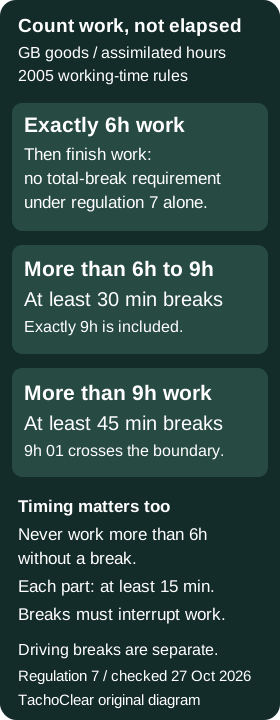
- Exactly six hours, then finish work: regulation 7 does not itself require the 30-minute total. You cannot continue working beyond six hours without a break. A driving break or another applicable requirement can still be due earlier.
- Six hours and one minute through exactly nine hours of work: at least 30 minutes of breaks in total, with no work stretch exceeding six hours.
- Nine hours and one minute of work: at least 45 minutes in total. The extra minute crosses the threshold; it is not a rounding allowance.
DVSA summarises the bands as "between 6 and 9 hours" in Annex 2. For the exact endpoints, regulation 7 says the work must exceed six hours, and the 30-minute band includes nine hours.
Nine hours of work can take nine and a half hours
Consider an illustrative day starting at 06:00 after sufficient rest, with no earlier driving in the driving period. Each work block contains one hour of driving followed by two hours of loading, checks or other transport work. Each break is uninterrupted, free of driving and other work, and used to recuperate. There is no POA in either example. Times are local.
- 06:00 to 09:00: three hours of work.
- 09:00 to 09:15: 15-minute break.
- 09:15 to 12:15: three hours of work.
- 12:15 to 12:30: another 15-minute break.
- 12:30 to 15:30: three hours of work, then finish.
The totals are nine hours of work, 30 minutes of breaks and nine hours 30 minutes elapsed. Driving totals three hours; other work totals six. No work block exceeds three hours. The 30-minute working-time break total fits regulation 7(2), even though the elapsed day exceeds nine hours.
Driving, loading and walkaround checks count as work; genuine breaks do not. See regulation 2's working-time definition and DVSA's explanation of what counts as work.
Plan a longer break if the work will pass nine hours
Suppose the final block needs one extra minute of other work. Plan for that before the second break: take 30 minutes from 12:15 to 12:45, then work from 12:45 to 15:46. The first break stays at 15 minutes. The final block contains one hour of driving and two hours one minute of other work.
Now the day totals nine hours one minute of work, 45 minutes of breaks and nine hours 46 minutes elapsed. Driving remains three hours; other work is six hours one minute. The longest work block is three hours one minute. The increased break total meets regulation 7(3).
Do not add a nominal break after all work has finished to repair a missing total: regulation 7 requires the break to interrupt the work. If the plan changes, reassess the remaining work and breaks before continuing.
The driving clock still needs its own check
Both examples keep total driving below four hours 30 minutes. Their working-time break plans are not permission to drive longer without checking the driving rule. Under Article 7 of Regulation (EC) 561/2006 as it has effect in the UK, after four hours 30 minutes of accumulated driving you need an uninterrupted break of at least 45 minutes, unless taking rest. The split alternative is at least 15 minutes followed by at least 30, appropriately placed. Two 15-minute stops do not complete that driving split.
Article 4(d) defines a driving break as time free of driving and other work, used exclusively for recuperation. DVSA explains the interaction in its working-time limits guidance. These examples test break timing and totals only; other daily and weekly limits and required rest remain separate checks.
Before the next job is added, check the actual work total, the longest stretch without a break and the driving since the last qualifying driving break. Use TachoClear to keep the activity record visible alongside your tachograph. Follow the two-break-clocks walkthrough for an earlier working-time stop, or the split-break alternatives when driving is the limiting clock.