
TachoClear lets you record other work separately from driving. Start your shift record with the work you actually did before taking over the vehicle, so the earlier hours remain visible when you plan a break.
Scope: an employed solo goods-vehicle driver working wholly in Great Britain under assimilated drivers' hours rules and covered by the Road Transport (Working Time) Regulations 2005. The worked day uses one transport employer. It excludes GB domestic-only driving, Northern Ireland's separate working-time rules, passenger services, multi-manning and international/AETR journeys.
Start with the work, then check the record
Loading and walkaround checks count as working time. The definition in regulation 2 of the 2005 Regulations covers transport activities and the relevant time at your workstation. DVSA's working-time annex includes work in the warehouse or office. The card-insertion time does not erase those duties.
For the tachograph record, Article 6(5) of Regulation (EC) 561/2006, as it has effect in the UK, requires other work to be recorded. When you were away from the vehicle and unable to use its digital tachograph, Article 34(3)(b) of Regulation (EU) 165/2014 requires those activities to be entered onto the driver card using its manual-entry facility. This example assumes the earlier work has not already been captured on an analogue record sheet.
- Write down the start and end of each activity since the last recorded period.
- Separate driving, other work, availability and rest or breaks according to what actually happened.
- Use the tachograph’s manual-entry process to record any uncovered activity; consult the maker’s instructions for that unit rather than guessing a button sequence.
- Check the resulting record against your own times and correct any error using DVSA’s procedure.
Two hours in the depot before the card goes in
This is an illustrative day, with sufficient previous rest, no earlier driving in the driving period and no earlier break. All times below are local. The driver loads in the same transport depot, takes over the lorry at 08:00 and then performs checks.
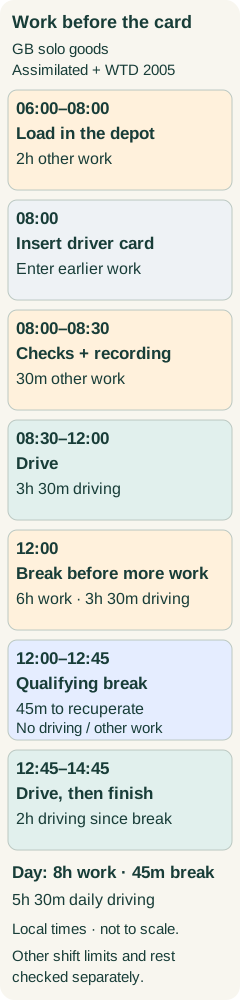
- 06:00–08:00: load in the warehouse, two hours of other work away from the vehicle.
- 08:00–08:30: insert the card, enter the earlier work accurately and carry out checks; 30 minutes of other work.
- 08:30–12:00: drive for 3 hours 30 minutes.
At 12:00, working time totals six hours: two hours loading, 30 minutes of checks and 3 hours 30 minutes driving. The driver must take a break before continuing work. Counting from 08:00 would miss the first two hours.
Regulation 7(1) prohibits more than six hours of work without a break. Exactly six hours is the boundary: continuing to 12:01 without a break would exceed it. A break can be due before driving reaches 4 hours 30 minutes.
Take one break that meets both tests
In this example the driver takes an uninterrupted 45-minute break, 12:00–12:45, free of driving and all other work and used exclusively to recuperate. They then drive from 12:45 to 14:45 and finish work.
A full qualifying driving break can be taken before reaching 4 hours 30 minutes. Under Article 7 and the break definition in Article 4(d), this 45-minute stop starts a new driving period. At 14:45, driving since the break is two hours; daily driving still totals 5 hours 30 minutes. A break does not erase the day's driving.
The completed day contains eight hours of work, 45 minutes of break and 8 hours 45 minutes elapsed. Work is interrupted after six hours, with two hours afterwards. Regulation 7(2) requires at least 30 minutes of breaks for more than six and up to nine hours of work; the 45-minute stop supplies that total too. DVSA confirms that a driving break can also meet working-time break requirements. Other daily/weekly limits and rest still need checking separately.
Make the earlier work visible
- Check the actual start and finish of each activity before inserting the card. Enter the two hours of warehouse work as other work, rather than accepting an incorrect rest entry.
- Check the tachograph's time basis when entering times. DVSA's digital tachograph guidance explains UTC and British Summer Time; the local times in this illustration are not universal input instructions.
- Ensure the employer's working-time record includes the earlier duties. DVSA notes that warehouse work may need additional records.
If an entry is wrong, follow DVSA's correction guidance: for a digital or smart tachograph, make and sign a printout for the relevant period, noting the error and reason at the time. Changing TachoClear's record does not amend your driver card.
What about a second job?
The other-work recording duty extends beyond the transport employer. Article 4(e) and DVSA's recording-other-work guidance include work for another employer, even outside transport. Tell the operator about it and keep the required record; do not treat paid work elsewhere as rest. This one-employer example does not calculate a combined week for a separate job or decide which working-time regime covers that job.
Before your next shift, check the first duty in your record and the first break in your plan. Use TachoClear alongside your tachograph to record the same real activities. For the two break requirements in more detail, see the two-clock working-time guide; for a wait instead of active work, see the POA depot example. If your van also makes international trips, check the weight, route and use conditions for vans over 2.5 tonnes.