
TachoClear helps you record driving, work and breaks separately. When a depot task interrupts a stop, record what actually happened and check the qualifying break parts before driving again.
Scope: solo goods-vehicle drivers working wholly in Great Britain under assimilated drivers' hours rules, with working-time notes for employed mobile workers covered by the Road Transport (Working Time) Regulations 2005. This example excludes Northern Ireland, GB domestic-only rules, international/AETR journeys, passenger operations and multi-manning. No temporary relaxation is applied.
Loading interrupts the break
A driving break must be free of driving and other work and used exclusively for recuperation: Article 4(d) and (e). Loading or helping to unload is work. Monitoring or supervising loading is also work; a parked vehicle and the tachograph's selected symbol do not make the activity a break. See DVSA Annex 2 and regulation 2's working-time definition.
Under Article 7, after four hours 30 minutes of accumulated driving, take at least 45 uninterrupted minutes unless taking rest. The standard split alternative is at least 15 minutes followed by at least 30, appropriately distributed. Adding separate stops until the total reaches 45 minutes is insufficient. DVSA's driving-break guidance explains the same distinction.
A break interrupted at 20 minutes
This illustrative sequence starts at 06:00 after sufficient rest, with no earlier driving or work. Both break parts are entirely free of work and used for recuperation. It tests the driving-break requirement at this point, not approval of the whole shift.
- 06:00 to 09:00: drive for three hours.
- 09:00 to 09:20: take a genuine 20-minute break.
- 09:20 to 09:25: help load for five minutes. Record other work.
- 09:25 to 09:50: take another 25 minutes off. The driving split is still incomplete.
- Stay on break until 09:55: the second uninterrupted part now lasts 30 minutes. The 20-then-30 split completes the driving-break requirement before any further driving.
WATCH THE BREAK PARTS
1 / 5A stop interrupted by loading
GB solo goods · assimilated rules · stop starts after three hours of driving
A planned break, before the driving limitThree hours of driving are complete. This example starts its stop before four-and-a-half hours of driving.
- Total break time so far
- 0 min
Illustrative checkpoints, not a live app screen or a full shift check. Each break part is free of driving and other work and used for recuperation. Playback is compressed; use the controls to read at your pace.
Article 7: at least 15 minutes, then at least 30 · Article 4: a break is free of work
Read the full static timeline
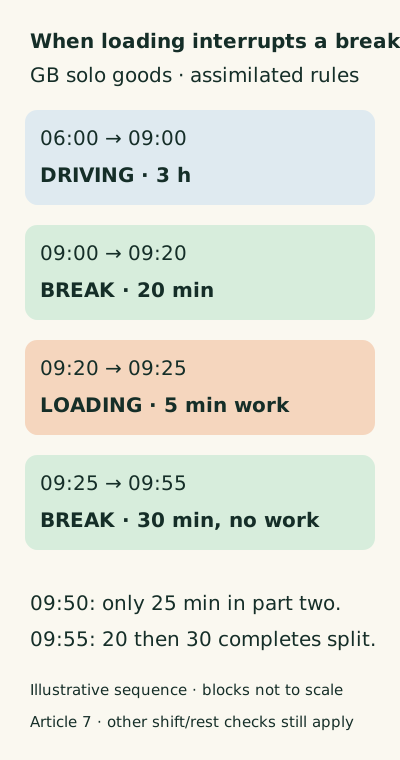
At 09:50, the break total is 45 minutes (20 + 25), but neither an uninterrupted 45 nor a qualifying 15-then-30 split has been completed. At 09:55, breaks total 50 minutes, work totals three hours five minutes (180 driving + 5 loading), and elapsed time is three hours 55 minutes. Loading has not reset the driving period.
What if the break parts differ?
- 14 minutes, work, then 30 minutes: the first part is below 15, so the split is incomplete. Do not add that 14-minute stop to the later 30 minutes and treat the split as complete. If still on the later break, extending it uninterrupted from 30 to 45 minutes completes a single 45-minute break.
- 15 minutes, work, then 30 minutes: the two durations meet the standard split minimum, provided they are genuine qualifying breaks and properly placed.
- 30 minutes, work, then 15 minutes: the second part is too short. See the reversed-split guide.
Keep the working-time check separate
For covered employed mobile workers, loading adds to work. Regulation 7 prohibits more than six hours of work without a break; total work exceeding six through nine hours requires at least 30 minutes of breaks interrupting work, and over nine requires at least 45. Separate parts must each last at least 15 minutes. See regulation 7(1) to (4). A working-time break total does not establish that the driving split is complete.
Before continuing, check the actual activity record, driving accumulated since the last completed qualifying break or rest, the length and order of break parts, and the separate work and rest requirements. Do not label loading as break to preserve a planned stop. Follow the two-clock walkthrough or the exact working-time thresholds for the wider shift checks.